How did Essendon get its name?
Essendon is named after a village in Hertfordshire, England. Who named it, when the suburb grew and how it went from gold-road stop to tram suburb.
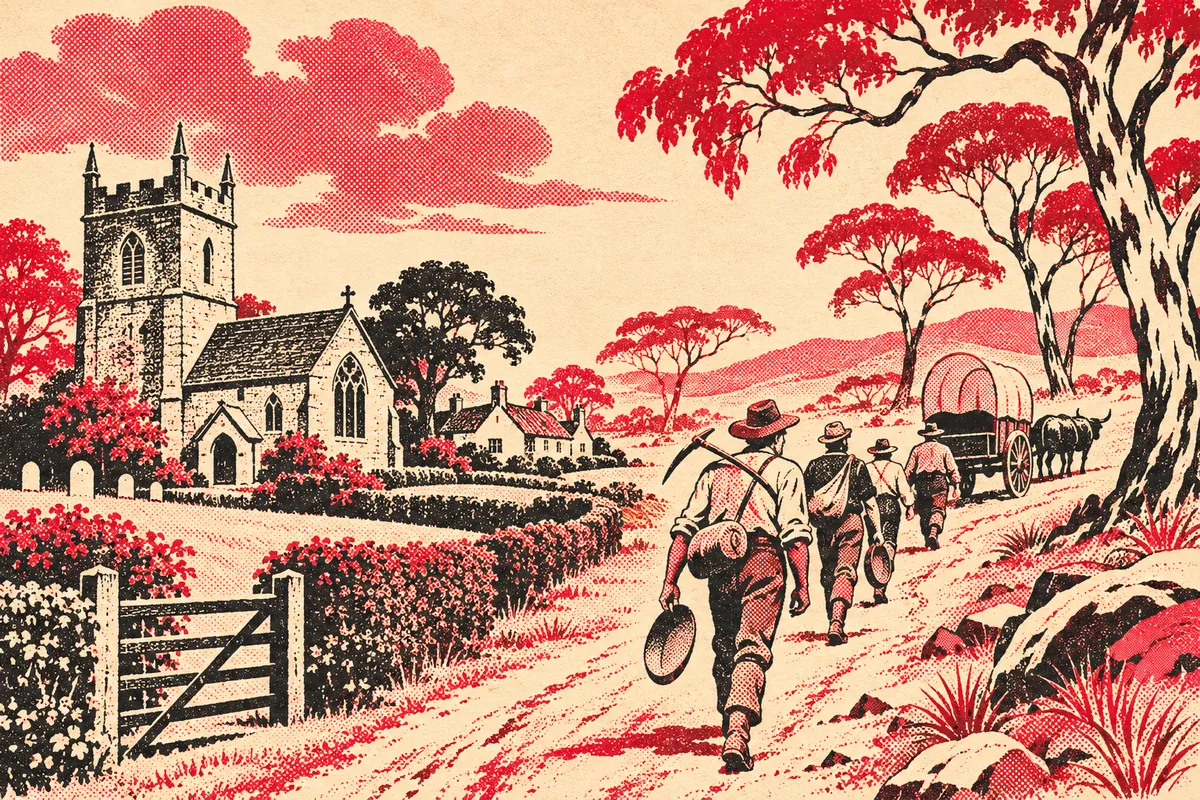
Essendon takes its name from the village of Essendon in Hertfordshire, England. Richard Green, an early settler who was born in that village, is credited with giving the name. The story was retold in The Argus on 3 February 1934 under the headline “How Essendon got its Name”.
Who lived here before the name?
The Wurundjeri people of the Kulin Nation are the formally recognised Traditional Owners of the land that Essendon now covers. Moonee Valley City Council acknowledges them as the area’s first custodians.
When did Essendon start to grow?
The gold rush of 1851 changed the district. Miners heading for Castlemaine and Bendigo travelled north-west along Mount Alexander Road, and inns, stores and farms grew up along the route. Essendon Post Office opened on 18 August 1856.
When did the railway arrive?
A private railway ran to Essendon from 1860 but failed and closed in 1864. Victorian Railways restarted services between Essendon and Melbourne on 9 January 1871. Today Essendon, Glenbervie and Strathmore stations are all on the Craigieburn line.
How did local government begin?
In 1862, 169 residents asked for a Borough of Essendon and Flemington to be formed. During the 1880s the council resisted cattle saleyards and brickworks, which helped keep the area residential. Essendon is now part of the City of Moonee Valley.
What came next?
- 1890: Earlsbrae Hall was built for Collier McCracken at a cost of £35,000. It is now part of Lowther Hall Anglican Grammar School.
- 1906: An electric tramway opened between Essendon and the city, run by the North Melbourne Electric Tramway and Lighting Company.
- 1921: The Essendon Football Club made Windy Hill its home ground, and Essendon Airport began operating.
- 1970: Melbourne’s international flights moved to Tullamarine.
Is Essendon the same as Essendon North or Essendon West?
No. Essendon North, Essendon West and Essendon Fields are separate suburbs with their own boundaries. Essendon itself uses postcode 3040 and had 21,240 residents at the 2021 Census.